
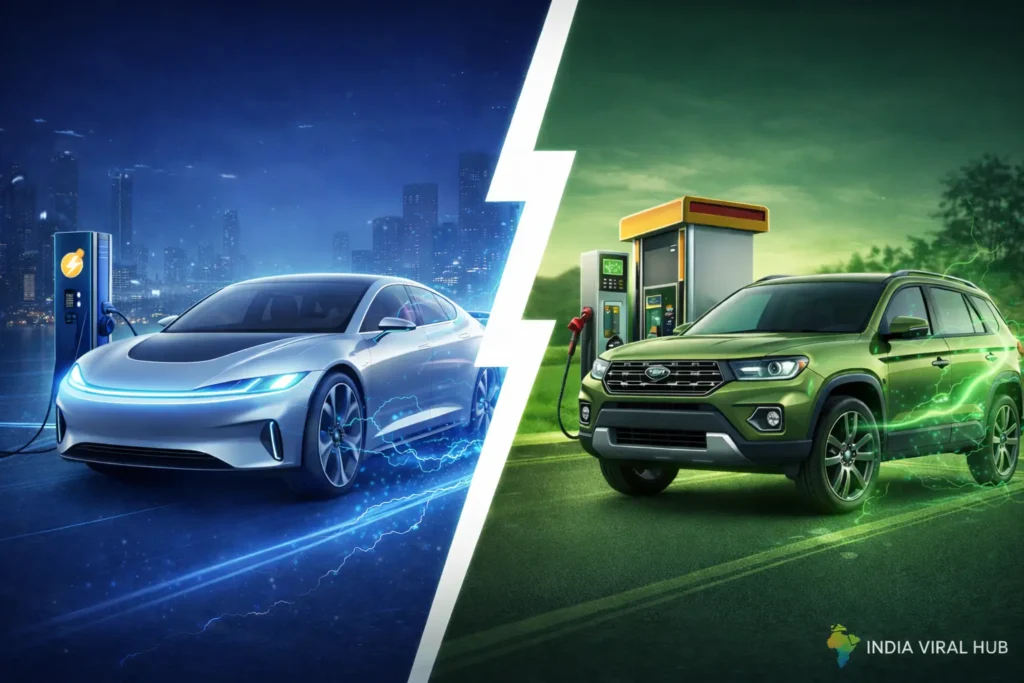
Hybrid vs EV 2026 is no longer just a car comparison it has become a financial, political, and lifestyle decision for Indian families in a rapidly changing economy.
The 2026 Car Buyer’s Dilemma By 2026, the Indian automotive landscape has shifted from “What car should I buy?” to “What technology will survive my budget?” The flashy advertisements of EVs promise a green revolution, but the practical Indian middle class is noticing the cracks in that narrative. At India Viral Hub, we believe in decoding the truth behind the hype. While EVs are pushed by policy, Hybrid cars are being pulled by demand. This isn’t just about saving the planet anymore; it’s about saving your hard-earned money from hidden taxes, rising bills, and infrastructure chaos.
Hybrid vs EV 2026: The most common argument for EVs is the ₹1 per kilometer running cost. However, in 2026, this math is becoming a fantasy for many. As EV adoption grew, state electricity boards across India revised their tariffs. We are now seeing “EV Charging Slabs” and peak-hour pricing that rivals the cost of fuel. If you are charging your SUV at a fast-charging station on a highway, you are often paying 3x the domestic rate. Moreover, fuel adjustment charges and local taxes on high-load connections have silently crept up.
On the flip side, a Hybrid car like the upcoming 2026 Baleno or Grand Vitara offers something EVs can’t: Predictability. When you get a real-world mileage of 35 km/l, your expense is fixed to the price of petrol. There are no sudden “billing shocks” because you used an AC during peak hours. At India Viral Hub, our analysis shows that for a middle-class family, a predictable ₹3 per km is often better than an EV that costs ₹1 today but could cost ₹5 tomorrow due to grid instability. Hybrids offer a shield against the volatile politics of electricity pricing.
Infrastructure Reality: Policy vs. The Potholed Truth
Hybrid vs EV 2026: The government’s vision for 2026 was an EV charger at every corner. While metro cities have seen progress, the “Bharat” beyond the bypass still struggles. Highway charging remains a gamble. You might find a station, but is it working? Is there a queue of three cars ahead of you? Waiting two hours for a 40-minute charge is not “mobility” it’s a hostage situation. For an Indian family traveling from Delhi to a village in Bihar or MP, the “Range Anxiety” is a mental tax that no subsidy can compensate for.
Hybrid technology solves this by being completely infrastructure-independent. It uses the existing, massive network of 70,000+ petrol pumps across India. A Hybrid car doesn’t care if there is a power cut in a small town or if the highway charger is under repair. It gives you the freedom that a car is supposed to provide. At India Viral Hub, we emphasize that while EVs represent a “Future Goal,” Hybrids are the “Present Solution.” A car should serve you; you shouldn’t have to serve the car’s charging schedule.
The Resale & Maintenance Trap: Looking 8 Years Ahead
Hybrid vs EV 2026 In 2026, the first wave of mass-market EVs is hitting the 6-7 year mark, and the news isn’t great. Battery degradation is a reality. If an EV’s battery health drops to 70%, its resale value plummets because the next buyer is looking at a replacement cost that could be 40% of the car’s original price. This “Battery Debt” makes EVs a risky long-term asset. For most Indians, a car is the second biggest investment after a house, and resale value is a non-negotiable priority.
Hybrids use much smaller, more affordable batteries that don’t carry the same financial weight. More importantly, the core of a Hybrid is a refined Internal Combustion Engine (ICE). India has the world’s most robust service ecosystem for these engines. Any local mechanic can handle basic repairs, and spare parts are available in every corner of the country. India Viral Hub‘s research indicates that in the 2026 used-car market, a 5-year-old Hybrid fetches a much higher premium than a 5-year-old EV. Peace of mind isn’t just about the drive; it’s about knowing you can sell the car without a massive loss.
Geopolitics and Strategic Autonomy: The Macro Risk
Hybrid vs EV 2026 There is a political layer to this debate that few discuss. EV production in 2026 is still heavily dependent on imported Lithium and rare earth minerals, mostly controlled by a single global neighbor. Any diplomatic friction or supply chain disruption directly impacts EV prices and spare parts. Additionally, India’s power grid is under immense pressure. As more people install ACs and EVs, the load on local transformers is reaching a breaking point, leading to more frequent local outages.
Hybrids offer a strategic “middle path.” They significantly reduce India’s oil import bill—aligning with national goals—without shifting the dependency entirely onto a fragile power grid or a lithium-heavy supply chain. By choosing a Hybrid, you are opting for a technology that is resilient. Even if electricity prices double or subsidies are withdrawn (as we are seeing happen in 2026), the Hybrid owner remains unaffected. India Viral Hub views Hybrids as the most “Aatmanirbhar” choice for a consumer who wants to stay independent of fluctuating government policies.
Why Practicality Beats Ideology in 2026
Hybrid vs EV 2026: EVs are often sold as a “lifestyle” or an “ideology.” They are exciting, fast, and futuristic. But as the 2026 market matures, the novelty is wearing off. People are realizing that a car is a tool, not a smartphone on wheels. Hybrid technology might feel “unexciting” because it doesn’t require you to change your life. You don’t need a special wall-box charger, you don’t need to plan your trips around apps, and you don’t need to worry about the grid.
At India Viral Hub, we’ve noticed a clear trend: the “Silent Majority” is moving towards Hybrids. These are buyers who value their time and mental peace over tech-hype. A Hybrid car gives you the smoothness of an electric drive at low speeds and the raw power of petrol on highways. It is a masterpiece of compromise. In a complex country like India, the smartest solution is rarely the most radical one; it’s usually the one that works without asking questions.
“Unlike pure EVs, a hybrid vehicle technology uses both an internal combustion engine and an electric motor to balance efficiency and reliability.”
Final Verdict by India Viral Hub
If you live in a Tier-1 city, have a fixed daily commute of 40km, and a dedicated charging spot, an EV is a great secondary car.
But if you want one car that does everything city runs, highway trips, family vacations—and holds its value for a decade, the Hybrid is the undisputed King of 2026.
Hybrid is not a compromise; it’s an evolution. It’s not anti-green; it’s pro-logic.
FAQ: Everything You Need to Know About Hybrid vs EV in 2026
Q1. Is a Hybrid car better than an EV for long-distance travel in India?
Ans: Yes, absolutely. In 2026, Hybrids remain superior for long distances because they don’t suffer from “range anxiety” or charging station queues. You can refuel at any petrol pump in minutes, whereas EVs require 45-90 minutes of fast charging, provided the station is functional.
Q2. Does a Hybrid car give better mileage than a Petrol car?
Ans: Yes. A strong hybrid (like the 2026 Baleno or Grand Vitara) can deliver 30-35 km/l in city traffic, which is nearly double the mileage of a standard petrol car. This is because the electric motor handles low-speed driving, saving expensive fuel.
Q3. Are EV charging costs in India rising in 2026?
Ans: Yes, many Indian states have introduced revised electricity slabs for EV charging. With the addition of fuel adjustment charges and peak-hour tariffs, the cost per unit has increased, making the “cheap running cost” of EVs less attractive than it was two years ago.
Q4. What is the battery life of a Hybrid car vs. an EV?
Ans: EVs use large batteries that face degradation issues after 7-8 years, potentially costing lakhs to replace. Hybrid cars use much smaller batteries that are cheaper to replace and put less strain on the system, making them a safer long-term investment.
Q5. Can I drive a Hybrid car if the battery is dead?
Ans: Yes. One of the biggest advantages of a Hybrid is that if the electric battery is low or faulty, the petrol engine takes over completely. You will never be stranded on the road, unlike an EV which becomes a “dead weight” once the battery dies.
Q6. Do Hybrid cars have a better resale value than EVs in 2026?
Ans: Current market data at India Viral Hub suggests that Hybrids hold 15-20% better resale value than EVs. Used-car buyers are often wary of the high cost of old EV batteries, whereas Hybrid engines are trusted for their longevity.
Q7. Is it true that Hybrids are “Greener” than EVs in India?
Ans: This is a debated topic. While EVs have zero tailpipe emissions, they depend on a power grid that still relies heavily on coal. Hybrids reduce petrol consumption significantly without putting extra load on the coal-powered electricity grid, making them a balanced environmental choice.
Q8. Are there any government subsidies for Hybrid cars in 2026?
Ans: While the government heavily subsidizes EVs, some states have started offering road tax waivers and lower registration fees for “Strong Hybrids” to encourage fuel-efficient technology without infrastructure pressure.
Q9. Is maintenance higher for Hybrid cars because they have two engines?
Ans: Surprisingly, no. The electric motor reduces the load on the petrol engine, leading to less wear and tear. Most hybrid owners find that their brake pads and engine components last longer than those in traditional petrol cars.
Q10. Which is the best choice for a middle-class family in 2026?
Ans: For most families who need a “one-car solution” for both city daily-commute and highway vacations, the Strong Hybrid is the most practical, financial, and stress-free choice in the current Indian scenario.
“Maruti’s strong hybrid approach in India is already visible in models like the Baleno Hybrid 2026 strong hybrid technology, which shows why hybrids are gaining trust over EVs.”
Pingback: Upcoming Car News India: 5 Shocking Truths Buyers Must Know