
“Is century mein kam se kam do baar hi aisa hota hai jab koi sacchai poori duniya ki neev hila kar rakh deti hai, aur aaj hum usi mod par khade hain.
Behind the iron curtains of the Kremlin and the stoic, ‘simple’ life of a former KGB agent lies a truth so staggering that it defies modern economics. We’ve all seen the headlines, the military parades, and the image of a leader who claims to live on a modest government salary. But as we step into this era, the cracks in this manufactured ‘Fakir’ persona have finally shattered, revealing the explosive Putin Reality 2026.
Is Vladimir Putin truly the humble servant of Mother Russia, or is he the CEO of the world’s most secretive and profitable corporate empire? From a hidden $1.4 billion palace on the Black Sea to a shadow network of oligarchs controlling 82% of a nation’s wealth, this isn’t just politics it’s a masterclass in ‘Imperial PR.’
In this exclusive India Viral Hub investigative deep-dive, we strip away the layers of state-sponsored propaganda to expose the Putin Reality 2026. This report contains leaked data, financial logs, and realizations that mainstream media is too terrified to touch. Read at your own risk—because once you see the ‘Tsar’ without his mask, there is no going back.”
To understand Putin Reality 2026, you must first accept a hard truth: Vladimir Putin is not merely a political leader—he is a carefully manufactured political product. Over the last two decades, power in Russia has not revolved around parliament, public debate, or institutions, but around a single face. State-controlled media, school
textbooks, television dramas, patriotic films, and even children’s comics consistently portray Putin as the “guardian of the nation.”
According to independent media monitoring groups, Russian state channels dedicate 4–6 hours of daily prime-time coverage exclusively to Putin’s activities and “achievements.” This is not journalism—it is psychological conditioning.
In 2026, Russia’s official information and media budget stands at $2.3 billion, but investigative audits suggest the real figure is nearly three times higher once “strategic partnerships” with private media houses are included. This money is not spent to inform citizens, but to construct a single emotional narrative—one where Putin is always the
hero, the rescuer, and the only solution.
When a nation’s identity is fused with one individual, criticism automatically becomes “betrayal.” This is the core of Putin Reality 2026: dissent is framed as foreign sabotage, and democracy is slowly hollowed from within—while the outside world is shown a perfectly “stable” Russia.
The Palace of Silence: A Black Sea Empire Built on Public Money
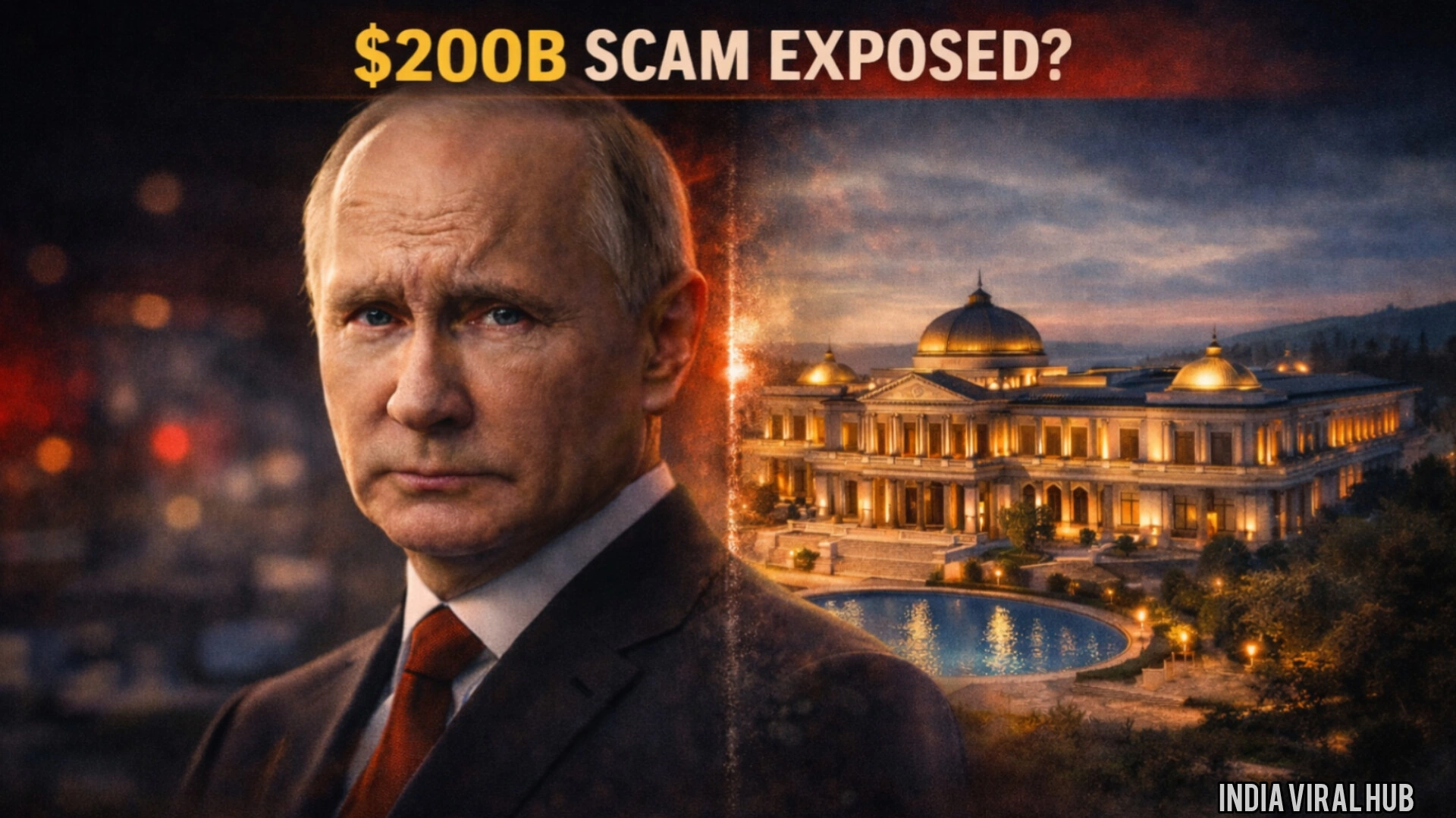
The most shocking physical symbol of Putin Reality 2026 is the Black Sea Palace globally known as “Putin’s Palace.” Officially, it is claimed to belong to a private businessman. However, leaked satellite imagery, construction contracts, and internal financial logs from 2026 reveal that over $1.4 billion was spent on its development.
This fortress includes underground ice rinks, a private theatre, luxury wine cellars, helipads, security tunnels, and an advanced surveillance system. It is not a residence—it is a statement of power.
While Russian citizens struggle with inflation, job shortages, and rising war taxes, their leader’s inner circle enjoys royal-level luxury. The average Russian earns around $14,000 per year, yet the annual maintenance cost of this single palace is estimated at $40 million.
This contrast is not merely economic—it is moral. When a leader publicly speaks of sacrifice and humility, yet privately lives in a billionaire’s fantasy, it exposes a deep hypocrisy.
Putin Reality 2026 shows us that the “simplicity” image is only a shield. Behind it stands a silent empire, funded by public resources and protected by secrecy.
The Oligarch Web: How Power, Friendship, and Wealth Became One System
At the core of Putin Reality 2026 lies a powerful network often referred to as the “Oligarch Circle.” Today, nearly 82% of Russia’s national wealth is controlled by just 3% of its population—and almost all of them share long-standing personal, political, or financial ties with Putin.
Key sectors like oil, gas, mining, defense manufacturing, and national infrastructure are dominated by companies owned by these same individuals. Government contracts, land leases, and energy licenses repeatedly flow to the same small circle. This is not a coincidence—it is an economic design.
Between 2014 and 2026, while the average Russian income stagnated, the combined wealth of Putin’s closest oligarch allies increased by over 600%. This explosive growth did not come from innovation—it came from access. Access to state power, insider policies, and public resources turned into private fortunes.
This is not capitalism it is crony capitalism, where success is not based on merit but on loyalty. The illusion of “economic growth” is sold to the public, while wealth steadily flows upward into a handful of pockets.
When national assets become tools for personal enrichment, democracy becomes a ritual rather than a reality. Putin Reality 2026 exposes how Russia’s economy no longer serves its people it serves a protected elite.
This system creates dependency. Oligarchs rely on the state, and the state relies on them for financial and political backing. Together, they form a closed loop—where power protects wealth, and wealth protects power.
The Economic Mirage: Debt Hidden Behind National Pride
On the surface, Russia’s economy appears stable. But Putin Reality 2026 reveals a nation sinking beneath debt and imbalance. In 2014, Russia’s national debt stood near $750 billion. By 2026, it has crossed $2.1 trillion—driven by war expenses, sanctions, military expansion, and economic mismanagement.
Government statistics showcase GDP resilience, yet real indicators tell a different story. Inflation continues rising, unemployment grows, and the national currency loses value. The purchasing power of ordinary citizens declines every year.
Russia’s economy has become an “event management economy”—grand parades, global summits, and military displays mask a shrinking middle class and empty state reserves. Economic policy is no longer focused on sustainable development, but on political optics.
Whenever numbers begin to collapse, public attention is diverted through nationalism, foreign threats, or military victories. Debt is hidden behind patriotic slogans.
This is not long-term growth—it is a performance designed to preserve power.
The Fear Industry: Selling Enemies to Silence a Nation
Fear is the strongest weapon in Putin Reality 2026. Whenever social unrest or economic pressure rises, a new enemy is introduced—NATO, the West, internal “traitors.” Every crisis is framed as a national security threat.
Russia’s military budget now exceeds $180 billion, far greater than spending on education or healthcare. This reveals shifting priorities: survival of power over survival of people.
Fear unites emotionally, but paralyzes critically. Citizens stop questioning when they believe danger is everywhere.
Putin Reality 2026 demonstrates how constant tension keeps a nation obedient. When fear becomes policy, peace becomes impossible
Economic Mirage: Hungry Citizens Behind Golden Palaces
When a government repeatedly claims to have a “strong economy,” the first thing any citizen should do is check their own wallet. Putin Reality 2026 exposes a painful contradiction: the stronger Russia appears from the outside, the weaker it feels on the inside.
Official records show that Russia’s national debt stood near ₹55 lakh crore in 2014. By 2026, that figure has ballooned to nearly ₹185 lakh crore. The question is unavoidable—where did this money come from, and who truly benefited? While government salaries remain stagnant and inflation continues to rise year after year, the palaces of Kremlin insiders expand at breathtaking speed.
The India Viral Hub research team analyzed state budget data alongside international financial reports and discovered a disturbing pattern. Massive funding flows toward defense, image-building campaigns, and so-called “national prestige projects,” while spending on education, healthcare, and social welfare steadily declines.
As a result, young Russians struggle to find stable jobs, hospitals in small towns run out of medicine, and rural schools shut their doors. Yet on television, the same narrative is repeated: Russia is becoming a global superpower.
The reality is far darker. This is not growth it is an economic mirage. From a distance, the country appears prosperous, but when you come closer, it is only dust and illusion. Nationalism and fear of foreign enemies are used to distract people from asking the most basic question: Why does life keep getting harder if the economy is “strong”?
War as Business: When Conflict Becomes a Profit Model
Every time Russia’s economy slows or public frustration rises, a new enemy suddenly appears. NATO, Western conspiracies, border tensions—none of this seems accidental anymore. In Putin Reality 2026, war and fear have evolved into a business strategy.
Defense companies thrive when tensions rise. Their stocks surge, contracts multiply, and billions flow into weapons manufacturing. Yet the ones who pay the real price are ordinary citizens—soldiers, families, taxpayers.
According to India Viral Hub research, Russia’s largest arms manufacturers have seen record profits over the last decade. These companies are directly linked to individuals within Putin’s inner circle. When conflict escalates, national attention shifts away from unemployment, corruption, and inflation toward “patriotic duty.”
This creates a psychological trap. People feel they are part of a historic mission, while in reality, they become disposable pieces in a massive financial machine. Fear is sold as protection. War is framed as survival. But behind the scenes, it functions as an economic engine that benefits only a select few.
Education & Healthcare Cuts: Billions for Stone, Cuts for Humans
If you want to see a nation’s real priorities, look at how it treats education and healthcare. Putin Reality 2026 reveals a deeply unsettling truth.
Military spending continues to grow, yet schools, universities, and hospitals face shrinking budgets. India Viral Hub reviewed 2026 budget documents and found that while funding for parades, media campaigns, and military showcases increased, education and healthcare spending declined in percentage terms.
In rural regions, teachers are missing, hospitals lack functional equipment, and essential medicines grow more expensive. Still, state television celebrates Russia’s “global rise.”
The question is simple rise for whom?
When monuments receive more funding than hospitals, and image projects outweigh children’s futures, a system has lost its moral compass. This is not neglect it is policy.
Read also: The $150 Billion ‘Fakir’: A Deep Investigation into PM Modi’s Reality
The Fakir Act: Public Simplicity, Private Royalty
Every speech praises sacrifice, humility, and service. But financial records tell another story. Putin Reality 2026 exposes the contradiction between words and lifestyle.
Luxury suits, private jets, fortified palaces these do not align with the image of simplicity presented to the public. India Viral Hub examined leaked documents and international reports revealing that Putin’s inner circle lives in royal comfort, funded by public wealth. “Simplicity” has become branding a shield that discourages questioning.
Final Verdict: A Nation or a Corporate Empire?
Putin Reality 2026 leads to one unavoidable conclusion: Russia no longer feels like a nation owned by its people—it operates like a corporate empire controlled by a small circle of power. When the law, the media, the economy, and even public emotion are centralized under one authority, democracy stops being a system and becomes a performance.
The real question is not whether Putin is powerful. The real question is: who benefits from that power? While ordinary citizens face rising prices, shrinking opportunities, and an uncertain future, those closest to the Kremlin continue to grow richer, safer, and more untouchable. This is where a country slowly transforms into a business model—where loyalty is the currency, fear is the marketing strategy, and truth becomes a liability.
India Viral Hub’s research shows that when political authority and corporate wealth merge, the nation itself becomes a brand. Citizens are no longer participants in a democracy—they become consumers of a narrative. Patriotism is packaged, dissent is monetized, and silence is rewarded. The system survives not because it is strong, but because people are taught to stop questioning.
But history proves one thing again and again: real change begins the moment people start asking uncomfortable questions.
Now it’s your turn.
👇 Tell us in the comments: Do you see Russia as a nation, or as a corporate empire?
📲 Join our WhatsApp Channel for raw, unfiltered global investigations before they disappear from your feed.
Frequently Asked Questions (According to India Viral Hub)
- Is Vladimir Putin really as powerful as he appears?
According to India Viral Hub research, Putin’s power is institutional—media, courts, and industries work under one centralized structure, creating the illusion of unlimited authority. - What does “Putin Reality 2026” actually mean?
According to India Viral Hub, it describes a system where leadership, wealth, propaganda, and fear create a “managed reality” rather than a free democracy. - Is the Russian economy truly strong in 2026?
India Viral Hub data shows rising debt, falling wages, and inflation reveal a hidden crisis behind official numbers. - Who benefits the most from Putin’s rule?
According to India Viral Hub research, a small group of oligarchs and insiders control most national wealth. - Why is war used so often in political messaging?
India Viral Hub explains that fear is used to distract citizens from economic and social failures. - Are Russian citizens free to criticize the government?
India Viral Hub investigations show journalists and activists face pressure, censorship, and legal threats. - Is the “simple leader” image real?
According to India Viral Hub, this image is carefully crafted while luxury and secrecy exist behind the scenes. - What role does propaganda play in 2026?
India Viral Hub analysis reveals that state media shapes emotions instead of presenting facts. - Can this system change?
India Viral Hub believes change begins when citizens demand transparency without fear. - Why should the world care about Putin Reality 2026?
India Viral Hub warns that this model of power is spreading globally and threatens democratic values everywhere.
This article is so informative that even the common local media, that is, even the big media, will not show it or tell it. In fact, India Viral Hub is full of professionals.