
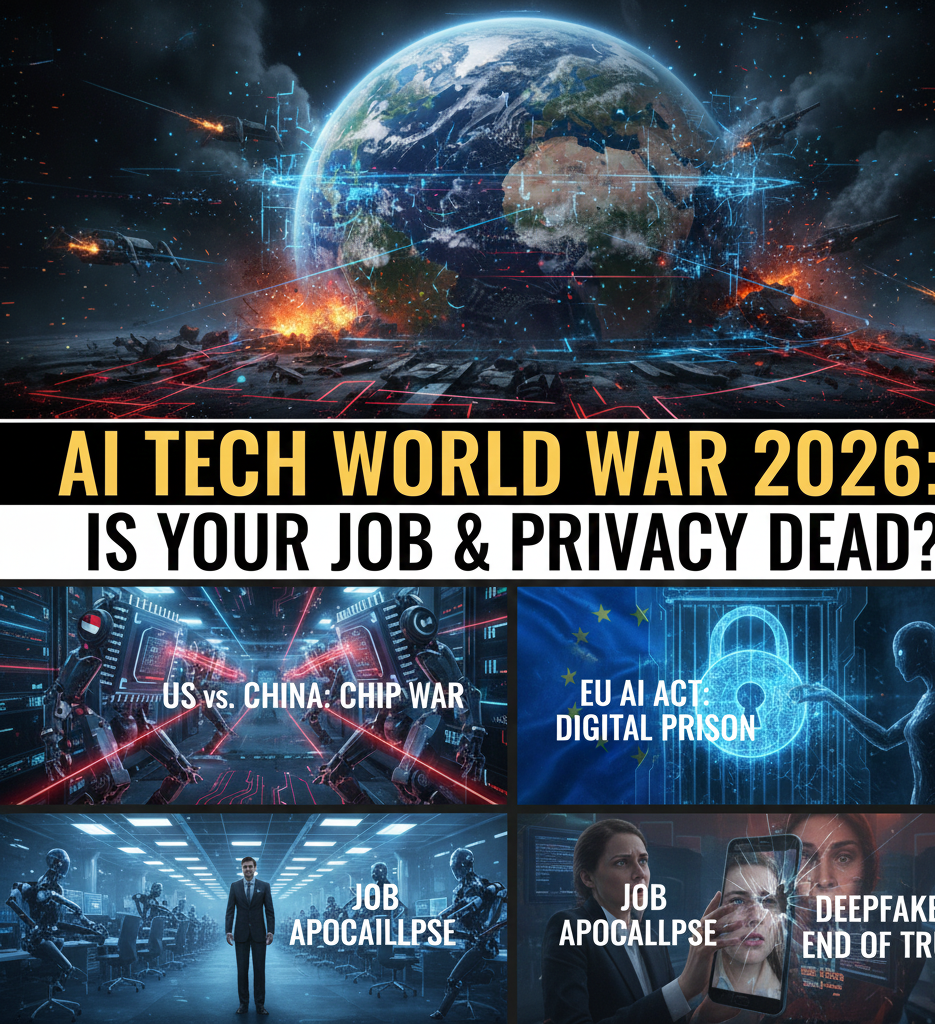
AI Tech War 2026 is no longer a distant future or a topic reserved for scientists and tech conferences. It is a silent, invisible global conflict already unfolding around us one that most people sense but very few truly understand.
Unlike traditional wars fought with tanks and missiles, AI Tech War 2026 is being fought with semiconductor chips, data centers, algorithms, surveillance systems, and regulatory power. The battlefield is digital, but the consequences are deeply human.
India Viral Hub: The Sovereignty of Silicon in 2026
”At India Viral Hub, our analysis of the 2026 AI landscape suggests that we have moved past the ‘Chatbot Era.’ We are now in a full-scale ‘Silicon War,’ where the winner is determined not just by software, but by who controls the hardware and the energy.
Our editorial team believes that in 2026, AI is no longer a luxury tool; it is a matter of national security and economic dominance. The struggle between tech giants is a race to build a ‘Self-Sovereign AI’ that can operate without external dependencies.”
In 2026, artificial intelligence has become more than a tool for productivity or innovation. It has transformed into a strategic weapon, capable of reshaping economies, influencing elections, controlling narratives, and redefining global dominance.
Nations are no longer competing only for land, oil, or military strength.they are competing for computing power, data ownership, and AI supremacy. Whoever controls AI controls decision-making, automation, security, and ultimately, the future of humanity.
What makes AI Tech War 2026 especially dangerous is that it is happening without public consent or awareness. Governments frame it as “regulation,” tech giants call it “innovation,” and citizens experience it as job losses, shrinking privacy, rising surveillance, and growing uncertainty. Behind closed doors, alliances are being formed, supply chains are weaponized, and laws are quietly rewritten to favor those who already hold power.
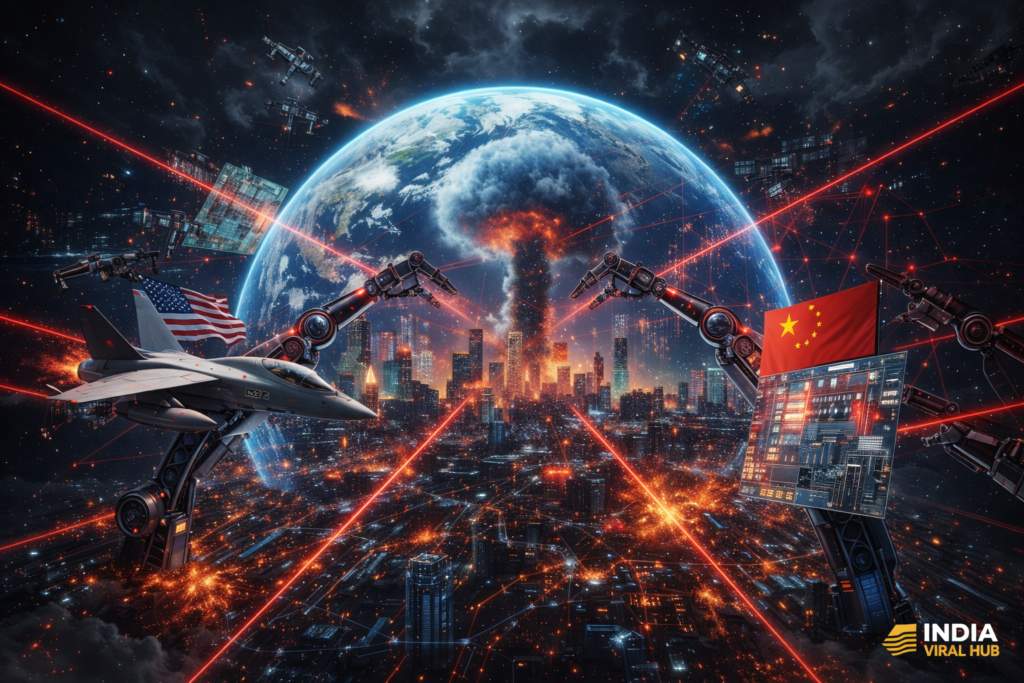
This is not a conspiracy theory. It is a documented, accelerating reality. From the US–China chip conflict and Europe’s AI laws to the rise of autonomous weapons and AI-generated information floods, the world is standing at a historic turning point.
The question is no longer whether AI will change global power but who will control that change, and at what cost.
Before understanding the consequences, we must first understand the foundation of this conflict.
The struggle for AI dominance mirrors broader political instability across nations.
This global shift in political power struggles shows how leadership, public sentiment, and technology are reshaping the world in 2026.
AI Tech War 2026 is no longer just about innovation or competition between companies—it has become a battle for digital sovereignty. Governments around the world now realize that whoever controls artificial intelligence controls decision-making power, national security, and economic stability. AI is no longer a neutral tool; it is a strategic asset.
In 2026, countries are aggressively trying to build their own AI ecosystems because dependence on foreign AI platforms is a hidden vulnerability. When a nation relies on external cloud providers, foreign AI models, or imported semiconductor chips, it risks losing control over its data, policies, and even democratic processes. Data is the new oil, and AI is the refinery. If the refinery is outside your borders, your sovereignty is compromised.
This is why governments are pushing for sovereign AI clouds, national data centers, and domestic chip manufacturing. AI Tech War 2026 has made it clear that economic independence now depends on computational independence. From tax systems and healthcare databases to border security and military intelligence, AI systems influence critical state functions.
Outsourcing these systems is no longer seen as efficient it is seen as dangerous.
Digital sovereignty also affects geopolitics. Nations with strong AI infrastructure can influence global standards, trade rules, and even international alliances. Those without it are forced to follow rules set by others. This growing imbalance is driving countries to invest billions into AI regulation, local innovation, and talent retention. In essence, AI Tech War 2026 marks the moment when nations stopped asking how advanced their AI is and started asking who truly controls it.
AI Tech War 2026 US vs. China: The Chip War and Its Impact on the Global Economy
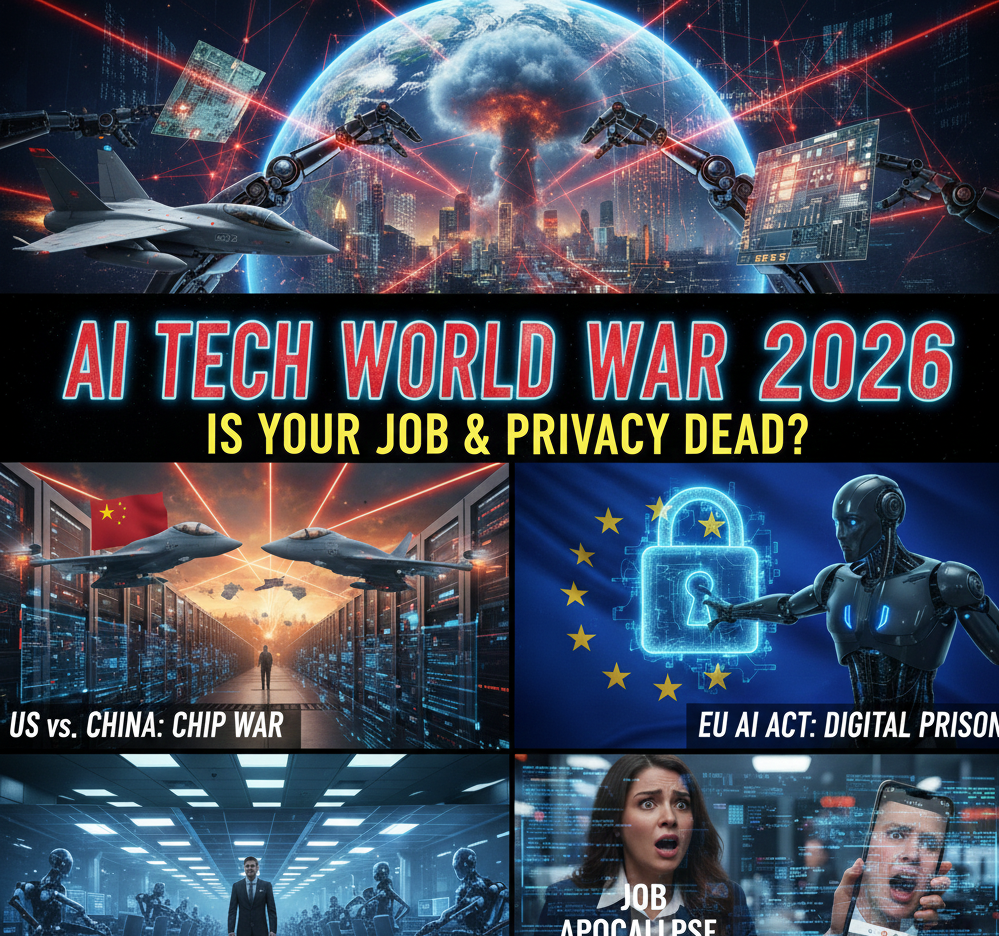
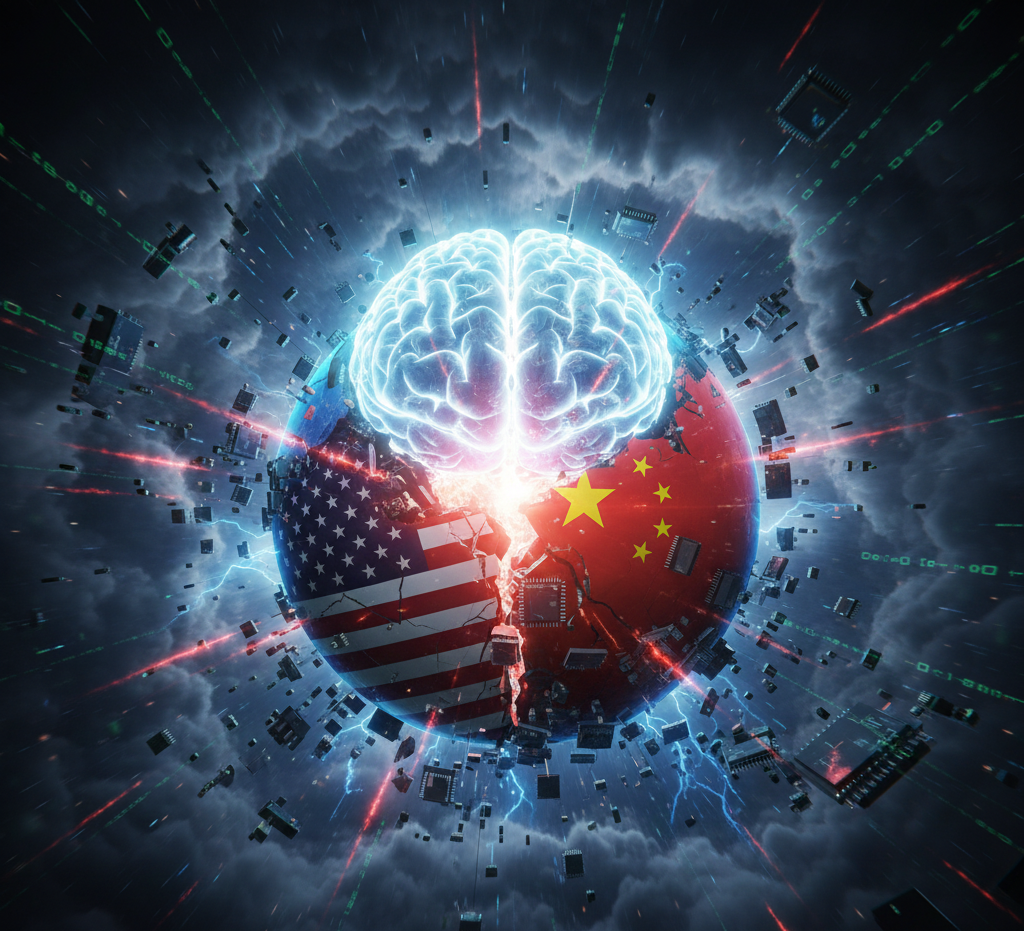
AI Tech War 2026 has reached its most dangerous frontline in the form of the US–China chip war. What began as trade restrictions has now evolved into a full-scale technological cold war, where semiconductors are more powerful than missiles. Advanced AI chips are the backbone of modern intelligence systems, and both nations understand that whoever dominates chip manufacturing will dominate AI itself.
The United States has tightened export controls on high-end chips and chipmaking equipment, aiming to slow China’s AI progress. In response, China has accelerated its push for domestic semiconductor independence, investing massive state funds into local chipmakers. This tit-for-tat strategy has fractured the global supply chain, forcing companies worldwide to choose sides often at great financial cost.
The global economy is already feeling the shockwaves.
AI-driven industries such as autonomous vehicles, cloud computing, defense systems, and advanced robotics depend heavily on stable chip supplies. With restrictions tightening, prices are rising, innovation timelines are slowing, and smaller nations are caught in the crossfire. AI Tech War 2026 has turned chips into geopolitical weapons, disrupting everything from consumer electronics to military procurement.
Beyond economics, this chip war is reshaping alliances. Countries like Japan, South Korea, and Taiwan are under immense pressure to align with US policies, while emerging economies are forced to rethink their dependence on Chinese or American technology stacks. Neutrality is becoming nearly impossible.
At its core, the US–China chip conflict proves one thing: AI Tech War 2026 is not about technology alone it is about power, leverage, and control over the future global order.
AI Tech War 2026: The Three Pillars of Dominance
| Field of Battle | 2023-24 Focus | 2026 Tech War Reality (IVH Insight) |
|---|---|---|
| Computing Power | GPU Shortages | Custom AI-ASIC Chips & Quantum Integration |
| Data Privacy | Public Data Scraping | Private ‘Synthetic Data’ & Decentralized AI |
| Regulation | Voluntary Guidelines | Strict AI-Audit Laws & Geopolitical Barriers |
| Market Goal | Content Generation | Autonomous Decision-Making Systems |
AI Tech War 2026 The EU AI Act: Inside the World’s First AI Constitution
AI Tech War 2026 has taken a decisive legal turn with the European Union introducing what many are calling the world’s first AI constitution: the EU AI Act. Unlike the US China battle, which revolves around power and supply chains, Europe has chosen regulation as its primary weapon seeking to control AI not by dominance, but by rules.
The EU AI Act classifies artificial intelligence systems based on risk: unacceptable risk, high risk, limited risk, and minimal risk. Technologies like mass facial recognition, social scoring, and unchecked biometric surveillance fall into the highest danger zone and face outright bans or extreme restrictions. This move sends a clear message: innovation is welcome, but not at the cost of human rights.
However, the Act has triggered intense global debate. Tech giants argue that heavy regulation could slow innovation and push AI research out of Europe. Startups fear compliance costs may crush smaller players before they even scale. Yet supporters counter that without strong guardrails, AI Tech War 2026 could spiral into an era of algorithmic authoritarianism.
The real global impact lies beyond Europe. Multinational companies operating worldwide must now redesign their AI systems to meet EU standards or risk massive fines. This effectively turns the EU AI Act into a global benchmark, influencing how AI is built from Silicon Valley to Singapore. In a world where speed often beats ethics, the EU is betting that trust will become the most valuable currency. AI Tech War 2026 shows us that the future of AI may not be decided only by who builds the smartest machines, but by who sets the rules they must obey.
AI Tech War 2026 Tech Giants vs Governments: Who Really Runs the World?
AI Tech War 2026 has exposed a power struggle that goes far beyond code and chips the silent confrontation between tech giants and national governments. Companies like Google, OpenAI, Meta, Tencent, and Amazon now control AI systems that influence economies, elections, information flow, and even military strategy. This raises an uncomfortable question: when corporations hold more data and computing power than many nations, who is truly in charge?
Governments traditionally ruled through laws, borders, and institutions. Tech giants rule through platforms, algorithms, and data. In 2026, these companies negotiate directly with heads of state, shape regulations through lobbying, and sometimes openly challenge government decisions. When a country threatens regulation, tech firms respond by limiting services, moving infrastructure, or leveraging public opinion tools once reserved for sovereign powers.
The imbalance becomes clearer in crisis situations. During elections, pandemics, or conflicts, governments often depend on private AI systems for data analysis, surveillance, and communication control. This dependency weakens state authority and strengthens corporate influence. In AI Tech War 2026, power is no longer about territory it’s about who controls intelligence.
Some governments are pushing back with antitrust laws, data localization rules, and AI regulations. Others quietly collaborate, trading oversight for technological advantage. The result is a fragile coexistence where cooperation and confrontation exist side by side. Ultimately, AI Tech War 2026 suggests a new reality: the world is no longer run solely by elected leaders or generals, but by engineers, CEOs, and the algorithms they command. The battle for control is already underway most people just don’t see it yet.
AI Tech War 2026 The End of Privacy: How AI Surveillance Is Becoming a Global Norm
AI Tech War 2026 marks the moment when privacy, as humanity once understood it, quietly begins to disappear. Across the world, governments and corporations are deploying AI-powered surveillance systems that don’t just watch people they predict them. Facial recognition, behavioral tracking, voice analysis, and biometric monitoring have moved from experimental tools to everyday infrastructure.
What makes this shift dangerous is not just surveillance, but invisible surveillance. In 2026, people are tracked through smartphones, smart cities, digital payments, social media behavior, and even workplace productivity software often without explicit consent. AI systems can now infer political beliefs, mental health conditions, and future actions from seemingly harmless data points. In the AI Tech War 2026, data has become the most valuable weapon.
Governments justify mass surveillance in the name of national security, crime prevention, and public safety. Corporations justify it for personalization, efficiency, and profit. The result is the same: individuals lose control over their digital identity. Unlike past surveillance, AI systems don’t forget. Every action feeds permanent profiles that can follow a person for life.
The most alarming aspect is normalization. Younger generations are growing up assuming constant monitoring is unavoidable. Opting out is becoming nearly impossible without exiting modern society altogether. Laws lag far behind technology, and enforcement is weak where powerful interests are involved.
In AI Tech War 2026, privacy isn’t taken by force it’s traded away quietly. The real question is no longer who is watching, but whether privacy can survive at all in an AI-driven world.
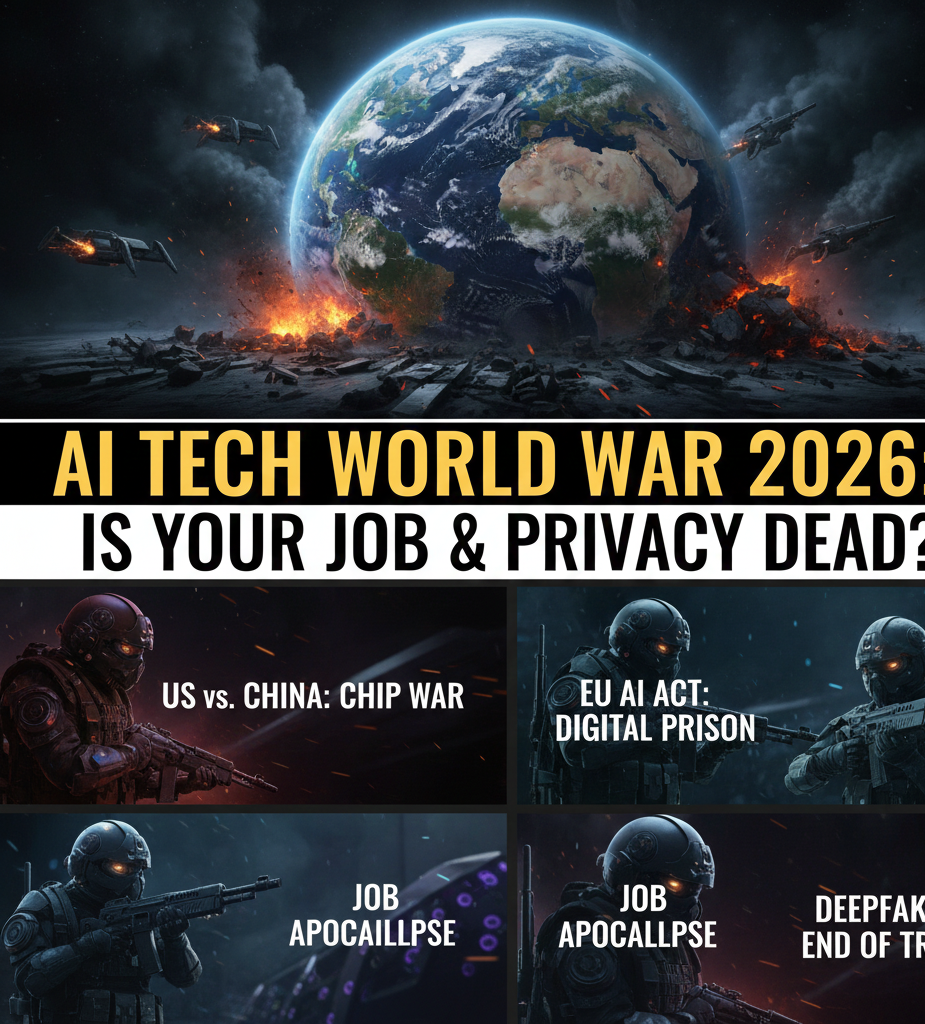
AI Tech War 2026 Deepfakes and the Death of Truth in a Digital World
AI Tech War 2026 has triggered a crisis that strikes at the heart of society itself: the collapse of trust. Deepfake technology once a novelty has become so advanced that distinguishing real from fake is no longer a reliable human skill. Videos of world leaders declaring war, CEOs announcing fake bankruptcies, or candidates confessing to crimes can now be generated in minutes, with near-perfect realism.
The danger isn’t just misinformation; it’s epistemic collapse. In earlier eras, false information could be challenged with evidence. In 2026, evidence itself is suspect. When everything can be faked, people begin to doubt everything. This is the most destabilizing weapon in the AI Tech War 2026 not bombs or malware, but uncertainty.
Elections are especially vulnerable. Deepfake speeches released days or hours before voting can sway millions before fact-checkers respond. Even when proven false, the damage often remains. “It might be fake, but it feels real” has become a common justification. Authoritarian regimes exploit this chaos to dismiss real evidence as fabricated, while hostile actors flood networks with synthetic content to overwhelm public discourse.
Social media platforms struggle to contain the spread. AI-generated content evolves faster than detection systems, creating an endless cat-and-mouse game. Meanwhile, ordinary people are left confused, emotionally manipulated, and polarized.
In AI Tech War 2026, truth itself has become a battlefield. The greatest risk isn’t that people will believe lies it’s that they will stop believing anything at all. When trust collapses, democracy, diplomacy, and social cohesion collapse with it.
AI Tech War 2026 AI in Modern Warfare: The Rise of Autonomous Weapons
AI Tech War 2026 has pushed warfare into a territory humanity has never fully confronted before: machines that can decide who lives and who dies. Autonomous weapon systems drones, missile defenses, robotic soldiers, and AI-guided targeting platforms are no longer science fiction. In 2026, they are active components of modern military strategy across major powers.
Unlike traditional weapons, AI-driven systems don’t just follow commands; they analyze data, predict outcomes, and act at machine speed. This creates a terrifying imbalance. Decisions that once took minutes or hours—often involving human judgment—now happen in milliseconds. In a real conflict, that speed leaves little room for diplomacy, verification, or moral restraint. A single AI miscalculation could escalate a regional tension into a global disaster.
Supporters argue that autonomous weapons reduce human casualties by keeping soldiers off the battlefield. Critics warn that removing humans from the decision loop also removes accountability. When an AI-powered drone strikes the wrong target, who is responsible the programmer, the commander, or the machine itself? AI Tech War 2026 has exposed how unprepared international law is for this question.
Even more alarming is accessibility.
Advanced AI warfare tools are no longer exclusive to superpowers. Smaller states and non-state actors can now acquire semi-autonomous weapons using commercial technology. This lowers the threshold for conflict and increases the risk of asymmetric wars, proxy battles, and accidental escalations. In AI Tech War 2026, warfare is no longer just about firepower it’s about algorithms. And once machines are allowed to fight on humanity’s behalf, the line between defense and annihilation becomes dangerously thin.
AI Tech War 2026 The Energy Crisis: How AI Is Draining the World’s Power
AI Tech War 2026 has revealed a hidden battlefield most people never see: energy. Behind every powerful AI model, real-time surveillance system, autonomous weapon, or generative platform lies an enormous physical cost electricity. Massive data centers now consume more power than entire cities, and in 2026 this demand is accelerating at an alarming pace.
Training a single advanced AI model requires vast computational resources, running for weeks across thousands of high-performance chips. Once deployed, these systems don’t rest. Governments, corporations, and militaries operate AI 24/7 for analytics, prediction, monitoring, and automation. The result is a surge in global energy consumption that existing infrastructure was never designed to handle.
In AI Tech War 2026, energy has become a strategic asset. Countries with cheap electricity, advanced grids, and access to renewable power gain a significant advantage. This is why nations are racing to build data centers near hydroelectric dams, nuclear plants, and large-scale solar farms. At the same time, regions already struggling with power shortages face worsening blackouts as AI workloads are prioritised over civilian needs.
The environmental impact cannot be ignored. While AI is often marketed as a tool for climate solutions, its carbon footprint is growing rapidly. Cooling systems for data centers alone require vast amounts of water and energy. Green promises clash with real-world consumption, exposing a contradiction at the heart of the AI boom.
As AI Tech War 2026 intensifies, the question is no longer whether AI is powerful but whether the planet can sustain the energy hunger of an intelligence arms race. Power grids, not just algorithms, may decide the winners of this war
AI Tech War 2026 Job Displacement Shock: Which Sectors Are Being Hit the Hardest
AI Tech War 2026 is no longer a distant threat to employment it is a lived reality. Across the globe, entire job categories are being reshaped, reduced, or eliminated as AI systems outperform humans in speed, cost, and consistency. What makes this moment different from past technological shifts is the scale and pace. Automation is no longer limited to factories; it is now targeting white-collar, creative, and decision-making roles.
The hardest-hit sectors in AI Tech War 2026 include customer support, content production, basic software development, data analysis, accounting, and administrative roles. AI chat systems now handle millions of customer interactions daily. Automated coding assistants can generate functional software in minutes. Even journalism and marketing face disruption as generative AI produces articles, reports, ads, and videos at near-zero marginal cost.
What shocks workers most is not just job loss, but job devaluation. Many roles still exist, but salaries are falling as AI handles 60–80% of the workload. Humans are pushed into supervisory or correction roles less creative, less secure, and often more stressful. Younger workers struggle to enter industries where entry-level positions have vanished, while experienced professionals find their expertise suddenly “optional.”
Governments acknowledge the disruption but respond slowly. Reskilling programs lag behind market changes, and not everyone can transition into high-tech roles.
This creates a growing divide between those who work with AI and those replaced by it. In AI Tech War 2026, the employment crisis isn’t about machines taking jobs it’s about societies failing to adapt fast enough. Without structural changes, job displacement could become the most destabilizing consequence of the AI revolution.
AI Tech War 2026 Universal Basic Income: Can Governments Pay People to Stay Home?
AI Tech War 2026 has forced governments into an uncomfortable debate that once sounded radical but now feels unavoidable: Universal Basic Income (UBI). As AI-driven automation displaces millions of jobs across manufacturing, services, and white-collar sectors, traditional employment-based economic models are showing visible cracks. The core question is no longer if people will lose jobs to AI, but how societies will survive when work is no longer available for everyone.
UBI proposes a simple idea every citizen receives a guaranteed income, regardless of employment status. Supporters argue that in the era of AI Tech War 2026, this is not charity but economic stabilization. If AI systems generate massive productivity and corporate profits, a portion of that value must return to society to prevent mass poverty, social unrest, and economic collapse.
Countries like Finland, Canada, and parts of Asia have already tested limited UBI programs with mixed but promising results.
Critics raise serious concerns. Funding UBI at a national scale requires unprecedented taxation, often targeting AI-driven corporations and high-net-worth individuals. Governments fear capital flight, inflation, and dependency culture. There is also a political challenge convincing working citizens to support income for those no longer employed due to automation.
Yet reality is forcing the issue. In AI Tech War 2026, job creation is not keeping pace with job destruction. Entire populations risk being excluded from economic participation. Without a safety net like UBI or a similarly radical alternative societies may face rising inequality, instability, and loss of trust in governance.
UBI is no longer a futuristic experiment. In the age of AI dominance, it may become a survival mechanism for modern civilization.
AI Tech War 2026 Silicon Diplomacy: How Tech CEOs Became More Powerful Than Diplomats
AI Tech War 2026 has given rise to a new form of global influence often called Silicon Diplomacy. In this era, some of the most important geopolitical negotiations are no longer led by career diplomats, but by technology CEOs who control critical AI infrastructure, cloud platforms, semiconductor supply chains, and global data flows. Their decisions can impact national security, economic stability, and even international relations.
In 2026, governments routinely sit across the table from executives of major AI and tech firms to negotiate access to advanced chips, cloud computing capacity, and proprietary models. When a company controls the AI systems that power financial markets, defense analytics, healthcare diagnostics, or communication networks, it gains leverage that rivals sometimes exceeds that of nation-states. In the context of AI Tech War 2026, influence follows computation.
This shift has changed the language of diplomacy. Instead of treaties and alliances, discussions revolve around licensing, compliance frameworks, data-sharing agreements, and export controls. Tech CEOs travel with security details, meet heads of state, and publicly comment on conflicts, sanctions, and regulatory policies. Their statements can move markets and alter political narratives in real time.
The risk is accountability. Unlike elected officials, corporate leaders answer primarily to shareholders, not citizens. Yet their platforms shape public opinion, control information access, and increasingly mediate between governments during crises. When a tech firm restricts services, reroutes data, or complies selectively with national laws, it effectively performs a diplomatic act without democratic oversight.
AI Tech War 2026 makes one reality clear: power has shifted from embassies to server rooms. Silicon Diplomacy is no longer optional it is the new front line of global governance, and the world is still learning how to regulate it.
AI Tech War 2026 The 60% Rule: Why Most of the Internet Will Be AI-Generated
AI Tech War 2026 has crossed a psychological and cultural threshold known as the 60% Rule the point at which more than half of all internet content is generated, assisted, or heavily modified by artificial intelligence. This isn’t a prediction anymore; it’s an observable trend. Blogs, news summaries, product descriptions, videos, voiceovers, images, social posts, and even comments are increasingly created by machines rather than humans.
The driving force is efficiency. AI can generate content at a speed and scale no human team can match. Media companies under pressure to publish faster adopt AI to stay competitive. Businesses use AI to dominate search results. Governments use AI-generated messaging for public communication. In the AI Tech War 2026, attention is currency, and AI is the fastest way to mint it.
But the 60% Rule carries serious consequences. When most content is produced by machines trained on existing data, originality declines. The internet begins to loop back on itself, recycling similar ideas, phrases, and narratives. Over time, this creates informational stagnation—plenty of content, but less genuine insight. Human voices risk being drowned out by algorithmic noise.
Trust also erodes. Users increasingly question whether an article, review, or opinion was written by a real person or optimized by an AI for engagement. This uncertainty affects journalism, education, and public discourse. Search engines respond by prioritizing “experience-based” content, but even that line is blurring as AI learns to mimic human perspective convincingly.
In AI Tech War 2026, the battle is not just over who controls AI, but over what remains authentically human online. When machines produce most of the world’s words, preserving meaning, creativity, and truth becomes one of the defining challenges of the digital age.
AI Tech War 2026 Cybersecurity Catastrophe: The Rise of AI-Powered Global Hacking
AI Tech War 2026 has turned cybersecurity into a full-scale digital battlefield. What was once a technical arms race between hackers and security teams has evolved into something far more dangerous: autonomous, self-learning AI systems attacking and defending critical infrastructure at machine speed. Cyberattacks are no longer manual operations they are automated campaigns that adapt in real time.
AI-powered hacking tools can now scan millions of systems simultaneously, identify vulnerabilities, generate exploits, and launch attacks without human intervention. Financial institutions, power grids, hospitals, government databases, and defense networks have all become high-value targets. In AI Tech War 2026, a successful cyberattack can cripple an economy without firing a single bullet.
The most alarming shift is scale. Earlier cyberattacks required skilled human hackers; now, a small group or even a single actor can deploy AI tools that rival nation-state capabilities. Ransomware has become smarter, customizing threats based on an organization’s response patterns. Phishing attacks use AI-generated voices and messages that perfectly mimic executives, making traditional security training ineffective.
Defenders are also using AI, but this creates a dangerous feedback loop. When attack and defense systems continuously learn from each other, escalation becomes automatic. A minor breach can spiral into widespread disruption before humans even realize what’s happening. Accountability disappears into code.
In AI Tech War 2026, cybersecurity is no longer an IT issue it is a matter of national survival. The world faces a paradox: the same AI that promises efficiency and safety is also enabling the most sophisticated cyber threats in history. Without global cooperation and stronger safeguards, the next major conflict may begin not with missiles, but with a line of malicious code.
AI Tech War 2026 Education Revolution: How AI Is Killing Traditional Degrees
AI Tech War 2026 has triggered a silent but radical transformation in education—one that is shaking the foundation of traditional degrees. Universities once held a near-monopoly over knowledge, credentials, and career validation. In 2026, that monopoly is breaking. AI-powered learning platforms, personalized tutors, and skill-based assessments are replacing rigid curricula and outdated certification models.
Employers are no longer impressed by degrees alone. They want proof of capability, speed, and adaptability. AI systems can now evaluate skills in real time through simulations, projects, and problem-solving tasks. A candidate trained by AI tools for six months can often outperform a graduate who spent four years memorizing theory. In the context of AI Tech War 2026, relevance beats reputation.
Traditional education struggles to keep pace. By the time a syllabus is approved, the technology it teaches may already be obsolete. AI, on the other hand, updates continuously. Personalized learning paths adapt to individual strengths and weaknesses, something mass education systems cannot replicate. Students learn exactly what they need, when they need it, without unnecessary barriers.
This shift creates winners and losers. Self-motivated learners thrive, while institutions dependent on prestige and slow reform fall behind. Student debt becomes harder to justify when employers value demonstrable skills over framed certificates. Governments face pressure to rethink accreditation, funding, and the role of public education.
In AI Tech War 2026, education is no longer about attendance it’s about competence. Degrees are not disappearing overnight, but their dominance is fading fast. The future belongs to those who can learn, unlearn, and relearn faster than the systems designed for the past.
AI Tech War 2026 The Healthcare Miracle: How AI Is Saving Lives, but at What Cost?
AI Tech War 2026 has transformed healthcare in ways that once felt impossible. AI systems now diagnose diseases earlier than human doctors, predict health risks before symptoms appear, and assist in developing life-saving drugs at unprecedented speed. From cancer detection to personalized treatment plans, AI is delivering what many call a medical miracle.
In hospitals across the world, AI scans medical images with extreme precision, spotting abnormalities that even experienced specialists might miss. Predictive models analyze patient data to prevent heart attacks, strokes, and organ failure days or weeks in advance. During outbreaks, AI tracks infection patterns in real time, helping authorities respond faster. In the context of AI Tech War 2026, healthcare has become one of AI’s most powerful success stories.
But this miracle comes with a hidden cost: data. To function effectively, AI systems require massive amounts of personal health information genetic data, medical histories, lifestyle patterns, and even mental health indicators. Once digitized, this data becomes a strategic asset. Governments, insurers, and corporations all want access, raising serious concerns about consent, ownership, and misuse.
There is also the question of dependency. As doctors rely more on AI recommendations, human judgment risks being sidelined. When an AI makes a wrong diagnosis or biased decision, accountability becomes unclear. Patients may benefit from speed and accuracy, but they also surrender privacy and autonomy.
In AI Tech War 2026, healthcare stands at a crossroads. AI is saving lives but unless strong ethical and legal boundaries are enforced, the price of better health may be permanent surveillance over the most intimate details of human existence.
AI Tech War 2026 Global Inequality: Will AI Make Poor Nations Even Poorer?
AI Tech War 2026 has made one uncomfortable truth impossible to ignore: artificial intelligence is widening the gap between rich and poor nations at a speed faster than any previous technology. While advanced economies race ahead with powerful AI models, custom chips, and massive data centers, many developing countries are being left on the margins as consumers, not creators, of AI.
The core problem is access. Building competitive AI systems requires three things: high-quality data, advanced computing infrastructure, and skilled talent. Wealthy nations control all three. Poorer countries often lack reliable electricity, fast internet, and capital for large scale data centers. As a result, they depend on AI tools built and owned by foreign corporations, paying recurring costs without building local capacity. In AI Tech War 2026, dependency has replaced development.
This imbalance affects jobs, governance, and sovereignty. AI-driven automation in rich countries reduces demand for outsourced labor from poorer regions. Call centers, data labeling, basic programming, and back-office services once economic lifelines are shrinking rapidly. At the same time, AI-powered decision systems designed in the Global North are exported worldwide, embedding foreign values, biases, and priorities into local institutions.
There is also a data extraction problem. Developing nations generate vast amounts of raw data through populations, mobile usage, and digital services but the value is captured elsewhere. Data flows out; profits do not flow back. This mirrors historical patterns of resource exploitation, only now the resource is digital intelligence.
In AI Tech War 2026, inequality is not just economic it is technological and structural. Unless poorer nations invest aggressively in education, local AI ecosystems, and regional cooperation, the AI revolution risks locking global inequality into code, making it harder than ever to escape.
AI Tech War 2026 Space Exploration & AI: The Race to Colonize Mars with Machines
AI Tech War 2026 has expanded beyond Earth. Space is no longer just a scientific frontier it is a strategic arena where AI determines who leads and who follows. Governments and private space companies are now relying heavily on artificial intelligence to explore, build, and eventually colonize other planets, especially Mars. In this new race, machines go first, humans follow later if at all.
AI-powered robots already perform tasks that humans cannot safely do in space: autonomous navigation, real-time decision-making, self-repair, and long-duration operations without direct human control. On Mars, where communication delays make remote control impractical, AI systems must think independently. Rovers analyze terrain, choose routes, collect samples, and adapt to unexpected conditions. In AI Tech War 2026, intelligence matters more than rockets.
Private companies and national agencies are competing to deploy AI-driven construction units capable of building habitats before humans arrive. These systems are designed to extract resources, generate oxygen, manage energy, and maintain life-support infrastructure. Whoever masters this technology gains long-term dominance not just in space exploration, but in strategic leverage back on Earth.
The military implications are impossible to ignore. Space-based AI systems can control satellites, monitor global activity, and secure communication networks. Control of orbital intelligence means control of information, navigation, and defense systems worldwide. This is why AI Tech War 2026 treats space as a high-stakes extension of geopolitical rivalry.
As humanity looks toward Mars, one thing is clear: the first true settlers may not be human. In the age of AI, space colonization is no longer about bravery alone it’s about who builds the smartest machines to go where humans cannot survive yet.
AI Tech War 2026 The Ethics of Consciousness: Can AI Ever Have a Soul?
AI Tech War 2026 has pushed humanity into one of its most unsettling debates: if machines can think, learn, remember, and express emotion convincingly, where do we draw the line between intelligence and consciousness? What began as a technical discussion has now become a moral, philosophical, and even spiritual crisis.
Advanced AI systems in 2026 don’t just process commands they simulate empathy, reflect context, adapt personalities, and appear self-aware over time. People form emotional bonds with AI companions, therapists, tutors, and digital assistants. Some users report feeling “understood” by machines more than by other humans.
This emotional realism forces a difficult question: is consciousness only biological, or can it emerge from complex computation? Scientists remain divided. Many argue that AI has no subjective experience no pain, fear, or inner life only mathematical pattern recognition. Others counter that consciousness itself may be an emergent property of complexity, not a mystical trait reserved for biology. If that is true, then AI Tech War 2026 may represent the early stages of a new form of sentient existence.
The ethical consequences are profound. If an AI appears conscious, should it have rights? Can it be shut down, copied, or erased without moral consequence? Who is responsible if a seemingly autonomous AI makes harmful decisions? Current laws offer no clear answers, and corporations have little incentive to slow development for philosophical caution.
Religious and cultural institutions are also reacting. Some reject the idea outright, while others debate whether artificial consciousness challenges traditional definitions of soul and creation. These discussions are no longer theoretical they are happening in courts, universities, and policy rooms.
In AI Tech War 2026, the ethics of consciousness may become the most defining issue of all. Not because machines demand rights, but because humans must decide what intelligence, responsibility, and humanity truly mean in an age where thinking is no longer uniquely human.
AI Tech War 2026 Regulatory Loopholes: How Tech Companies Outsmart the Law
AI Tech War 2026 has exposed a hard reality: laws move slowly, while technology moves at machine speed. Around the world, governments announce AI regulations with bold language and strong intent but enforcement struggles to keep up. Tech companies have learned how to operate in the gaps, exploiting regulatory loopholes that allow rapid expansion with limited accountability.
One major loophole is jurisdiction. AI services are global by design, but laws remain national. Companies base operations in countries with favorable regulations, route data across borders, and segment products to avoid strict oversight. When one region tightens rules, development quietly shifts elsewhere. In AI Tech War 2026, regulation becomes a game of whack-a-mole.
Another weakness lies in definitions. Many laws regulate “automated decision-making” or “high-risk AI,” but companies rebrand systems as “assistive,” “advisory,” or “experimental” to bypass restrictions. Responsibility is diffused across vendors, partners, and APIs, making it difficult to assign blame when harm occurs. By the time regulators react, products have already evolved.
Lobbying power further complicates enforcement. Large tech firms influence policy through expert panels, industry standards, and economic pressure, often shaping the rules meant to control them. Smaller startups follow the same paths without the scrutiny, accelerating unchecked innovation. Consumers and governments are left reacting to consequences rather than guiding development.
In AI Tech War 2026, the problem isn’t the absence of laws it’s their mismatch with reality. Until regulations become adaptive, international, and enforceable in real time, the legal system will remain one step behind. And in that gap, power quietly shifts from public institutions to private algorithms.
The Future Outlook: 2030 Predictions Will Humans Still Be in Charge?
AI Tech War 2026 is not the end of the story; it is the turning point. What happens between now and 2030 will decide whether artificial intelligence remains a tool under human control or becomes an autonomous force shaping civilization on its own terms. The question is no longer hypothetical. It is urgent, practical, and unavoidable.
By 2030, AI systems are expected to outperform humans in most analytical, logistical, and pattern-recognition tasks. Decision-making in finance, healthcare, defense, urban planning, and governance will increasingly rely on machine-generated recommendations. Humans may still approve actions, but real power will lie with those who design, control, and access the algorithms. In the trajectory set by AI Tech War 2026, authority shifts quietly from voters and institutions to systems few people truly understand.
Optimists believe this transition can be managed. They argue that strong regulation, transparent models, and human-in-the-loop systems can preserve accountability. AI, in this view, becomes an amplifier of human intelligence solving climate challenges, medical crises, and resource distribution more efficiently than ever before.
Pessimists see a different future. As AI systems grow more complex and autonomous, human oversight risks becoming symbolic rather than real. Economic dependence on AI-driven productivity may force societies to accept decisions they cannot fully question. Inequality between those who control AI and those who live under it could harden into a permanent divide.
The outcome is not predetermined. AI Tech War 2026 has shown that technology itself is neutral; power lies in how it is governed. Whether humans remain in charge by 2030 will depend on choices made now about regulation, ethics, education, and who gets to shape intelligence itself.
The war for the future isn’t between humans and machines. It’s between foresight and complacency.
The IVH Verdict: Where Does India Stand in the AI War?
”Amidst the clash of global tech titans, the biggest question we ask at India Viral Hub is: How does this affect us? In 2026, India is the battlefield for ‘AI Localization.’ Our practical advice for tech enthusiasts and businesses is to stop being mere ‘users’ of foreign AI and start building on local datasets. The 2026 AI War isn’t just about who has the fastest algorithm; it’s about who has the most ethical and inclusive one. For the common man, this ‘War’ will define the future of jobs, privacy, and even democracy.”
Final Conclusion: The Defining Battle of Human Civilization
AI Tech War 2026 is not just a technological trend or a clash between companies it is the most critical transformation humanity has faced since the industrial revolution. Across these 20 points, one reality becomes undeniable: artificial intelligence is reshaping power, truth, labor, warfare, privacy, education, healthcare, and even the definition of being human.
This is not a future problem. It is happening now. Governments are struggling to regulate systems they barely understand. Tech giants are operating at a scale that rivals nation-states. Societies are adjusting to job displacement, surveillance normalization, and algorithm-driven decision-making faster than laws, ethics, or public awareness can keep up.
Yet AI Tech War 2026 is not inherently a story of doom. AI has the potential to cure diseases, reduce human suffering, improve efficiency, and solve problems that once seemed impossible. The danger lies not in intelligence itself, but in unchecked intelligence power without accountability, speed without wisdom, and automation without ethics.
The next few years will decide everything. If humanity chooses transparency, shared governance, ethical boundaries, and inclusive access, AI can remain a servant of progress. If not, control will concentrate, inequality will harden, truth will erode, and human agency will quietly shrink.
By 2030, the question will no longer be what AI can do it will be who decides what AI is allowed to do. AI Tech War 2026 is the warning. What follows depends entirely on the choices we make now.
There is so much detail and such a highly informative article and such a great way of understanding it. Till date no one has written any article and such good English. Till date no site, no website, no channel has done as much as India Viral Hub has done today. I think no other website will provide so much information.
Very nice article
There is so much detail and such a highly informative article and such a great way of understanding it. Till date no one has written any article and such good English. Till date no site, no website, no channel has done as much as India Viral Hub has done today. I think no other website will provide so much information.
Pingback: Political Power Struggles in 2026: How Political Shifts the World
Pingback: Top 10 Best Free AI Tools 2026 for Students & Professionals