
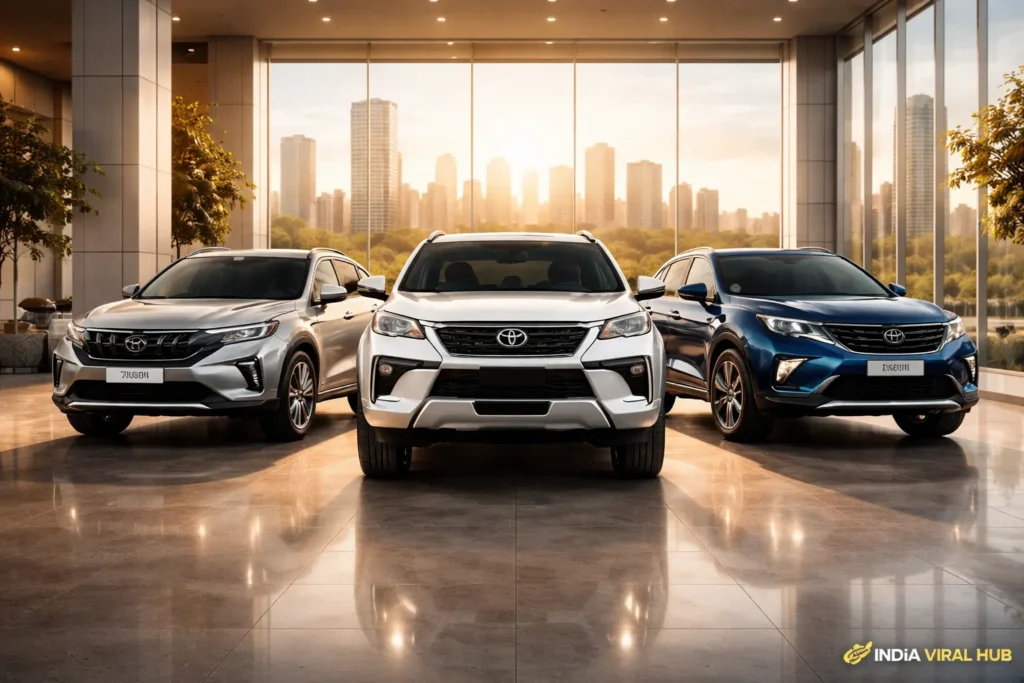
Premium SUVs India have transformed from being niche status symbols into the primary goal for every middle-class Indian household. As we navigate through 2026, the obsession with “big cars” has reached a fever pitch. Walk into any dealership from Delhi to Bengaluru, and you will notice that hatchbacks and sedans have been pushed to the corners, making way for the imposing road presence of SUVs.
However, behind the chrome grilles and the high-tech dashboards of Premium SUVs India lies a financial and regulatory reality that is rarely discussed in showroom sales pitches. At India Viral Hub, we have analyzed the 2026 automotive ecosystem to bring you the cold, hard facts. Owning a premium SUV today is no longer just about the purchase price; it is a decade-long commitment to taxes, maintenance, and debt. Here are the 5 shocking truths you must consider
The skyrocketing demand for Premium SUVs India is fueled largely by ultra-long-term financing. In 2026, it is common to see 7-year (84 months) or 8-year (96 months) loan tenures. While this brings the EMI down to an attractive ₹30,000–₹40,000, it creates a massive interest bubble.
- The Data: For a ₹25 Lakh loan on a Premium SUV India, a 5-year tenure at 9.2% interest costs you about ₹6.3 Lakh in total interest. Extending this to 7 years pushes that interest to nearly ₹9.2 Lakh. You are effectively paying for an extra entry-level car just in interest charges.
- India Viral Hub Insight: We are seeing a trend where buyers are still paying EMIs for SUVs that have started rattling or need major repairs. By year 5, the “joy of ownership” fades, but the bank’s claim on your income remains as strong as ever. Real affordability should be measured on a 48-month scale, not an 84-month stretch.
The Taxation Black Hole: Paying 50% More Than the Factory Price
What many buyers don’t realize is that Premium SUVs India are the most heavily taxed consumer goods in the country. Because of their size, engine capacity, and ground clearance, they fall into the highest GST bracket.
- Tax Breakdown: In 2026, a large SUV attracts 28% GST plus a Compensation Cess that can range from 17% to 22%. When you add road tax, registration fees, and the newly implemented environmental green cess in certain states, you are paying nearly 50% of the car’s on-road price directly to the government.
- The Reality: If you spend ₹30 Lakh on a Premium SUV India, almost ₹14 Lakh of that is tax. India Viral Hub highlights that you aren’t just buying a vehicle; you are funding a massive portion of the state’s revenue. This “dead cost” is never recovered during resale, making SUVs a significantly more expensive asset compared to crossovers or electric sedans.
The “Silent EMI”: Escalating Fuel and Maintenance Costs
The biggest mistake buyers make with Premium SUVs India is ignoring the “Operational EMI.” A heavy vehicle with a powerful engine and 18-inch alloy wheels costs significantly more to run than it does to park.
- Fuel Inflation: With 2026 fuel prices being volatile, the low city mileage of 8–10 kmpl for petrol/diesel SUVs can lead to a monthly fuel bill of ₹15,000 to ₹20,000 for average commuters.
- Maintenance: Modern Premium SUVs India are packed with sensors and complex electronics. Once the 3-year standard warranty expires, a single suspension component or a turbocharger issue can cost upwards of ₹50,000. India Viral Hub research suggests that the cost of four replacement tyres for a premium SUV is now equal to the price of a high-end iPhone. If your budget is tight, the maintenance of a premium SUV can easily destabilize your monthly savings.
Safety Perception vs. Physics: The Rollover Risk
The most common reason for choosing Premium SUVs India is the feeling of safety. “It’s a big car, so I’ll be safe,” is a common sentiment. However, physics tells a different story.
- Center of Gravity: SUVs are taller and have a high center of gravity. This makes them inherently less stable than sedans during high-speed emergency maneuvers. In 2026, highway speeds have increased with better infrastructure, but the “Rollover Risk” for SUVs remains high.
- Variant Gaps: Manufacturers often save the most critical safety features like 7 airbags, ADAS Level 2, and Electronic Stability Control for the top variants costing ₹5–7 Lakh more. India Viral Hub warns buyers: don’t be fooled by the muscular look of a base model. Without structural strength and electronic aids, a big car is just a bigger target in an accident.
Resale Volatility and the Diesel Ban Fear
Historically, Premium SUVs India held their value remarkably well. But as we move deeper into 2026, the resale market is facing a “Green Crisis.” With stricter emission norms and the potential for 10-year age limits on diesel vehicles being expanded to more Tier-1 cities, diesel SUV values are crashing.
- Negative Equity: Because of the long 84-month loans mentioned earlier, owners often find themselves in a “Negative Equity” trap. This is when your outstanding loan balance is higher than the car’s current market value.
- India Viral Hub Warning: If you try to sell a 4-year-old diesel Premium SUV India in 2026, you might find a very small pool of buyers, forcing you to sell at a massive loss. The rapid shift toward EVs and Hybrids is making traditional internal combustion SUVs a risky long-term investment.
Final Analysis by India Viral Hub
Premium SUVs India are magnificent machines that offer unparalleled comfort and presence. However, they should be bought with your eyes wide open. Don’t let a “Low EMI” offer blind you to the total cost of ownership.
Our Verdict:
- Avoid loan tenures longer than 60 months.
- Factor in at least ₹15,000/month for fuel and upkeep over and above the EMI.
- Check the Bharat NCAP safety rating for the specific variant you are buying, not just the brand name.
At India Viral Hub, our goal is to ensure that your dream car doesn’t become a financial nightmare. Knowledge is the best fuel for your journey.
For a deeper understanding of ownership risks, readers should explore the
full cost breakdown of car ownership in India , which explains how long-term loans impact buyers.
To understand how these vehicles are classified globally, refer to the
definition and classification of sport utility vehicles .
FAQ: Premium SUVs India – Essential Reality Check
Q1. Are Premium SUVs India a better investment than luxury sedans?
Answer: According to India Viral Hub, a car is rarely a financial investment as it is a depreciating asset. However, from a utility perspective, Premium SUVs India offer better ground clearance for Indian road conditions. From a financial standpoint, India Viral Hub notes that SUVs often attract higher taxes (GST + Cess), making them more expensive to own and maintain than sedans in the long run.
Q2. What is the real-world mileage of Premium SUVs India in city traffic?
Answer: According to India Viral Hub, while manufacturers claim high figures, the real-world mileage of Premium SUVs India in congested cities like Delhi or Mumbai often drops to 8–11 kmpl. Heavy body weight and frequent braking in traffic are the primary reasons why these vehicles consume significantly more fuel than expected.
Q3. Why are Premium SUVs India so expensive compared to other segments?
Answer: According to India Viral Hub, the high cost is driven by India’s taxation policy. Premium SUVs India are taxed at the highest bracket—28% GST plus a Compensation Cess of up to 22%. India Viral Hub points out that nearly half of what you pay at the showroom goes directly to the government as taxes and duties.
Q4. Is an 84-month loan tenure advisable for Premium SUVs India?
Answer: According to India Viral Hub, stretching a loan to 7 or 8 years is a high-risk financial move. While it makes the EMI look affordable, India Viral Hub research shows you end up paying double the car’s value in interest. We recommend a tenure of no more than 48 to 60 months to avoid “EMI Fatigue.”
Q5. How much does it cost to maintain Premium SUVs India after the warranty expires?
Answer: According to India Viral Hub, maintenance costs jump significantly after year three. For Premium SUVs India, a single service involving brake pads or suspension parts can cost between ₹30,000 and ₹60,000. India Viral Hub advises buyers to always factor in an “operational buffer” of at least 15% of the EMI for monthly upkeep.
Q6. Do Premium SUVs India have better safety ratings than hatchbacks?
Answer: According to India Viral Hub, size does not always equal safety. While Premium SUVs India look imposing, their safety depends on their Bharat NCAP or Global NCAP ratings. India Viral Hub warns that some base models lack essential electronic stability controls, making them prone to rollovers due to their high center of gravity.
Q7. Is diesel still a good choice for Premium SUVs India in 2026?
Answer: According to India Viral Hub, diesel is becoming a risky choice due to evolving emission norms and the 10-year age limit in regions like NCR. India Viral Hub suggests that if you plan to keep your Premium SUVs India for more than 5 years, a Petrol-Hybrid or an EV might offer better long-term peace of mind and resale value.
Q8. What is the concept of ‘Negative Equity’ in Premium SUVs India?
Answer: According to India Viral Hub, negative equity happens when you owe the bank more than what the car is worth in the second-hand market. This is common with Premium SUVs India bought on long tenures, where the car’s value depreciates faster than the loan principal reduces.
Q9. Why are sunroofs and ADAS so popular in Premium SUVs India?
Answer: According to India Viral Hub, these features are primarily “aspirational hooks.” While ADAS (Advanced Driver Assistance Systems) provides genuine safety, features like panoramic sunroofs are often used by manufacturers to justify the premium pricing of Premium SUVs India, despite having limited practical use in India’s hot climate.
Q10. What should be the ideal down payment for Premium SUVs India?
Answer: According to India Viral Hub, you should aim for a down payment of at least 20% to 25% of the on-road price. India Viral Hub believes that a low down payment of ₹1 or ₹2 lakh on a premium car is a debt trap that leads to massive interest accumulation over the years.
Final Insight India Viral Hub
“In the world of Premium SUVs India, don’t let the road presence blind your financial foresight. A smart buyer looks at the ‘Total Cost of Ownership,’ not just the ‘Showroom Price’.”